
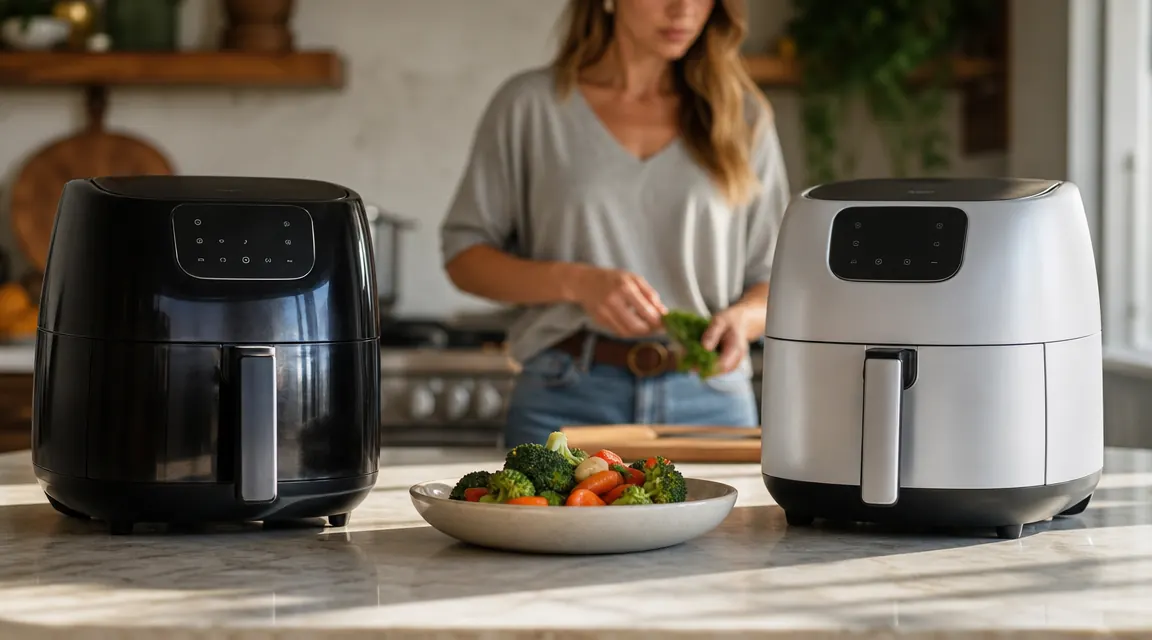
If you are in a small kitchen and you have narrowed your air fryer decision down to the Ninja 4 QT and the Instant Vortex 4 QT, you are already asking the right question. Both machines take up roughly the same counter footprint. Both are marketed toward compact kitchens. And on paper, the spec sheets look close enough that it is easy to talk yourself into thinking the cheaper one is the obvious call. I ran both machines through the same set of tests over three weeks to find out whether that logic holds up. The short answer: it does not, and the gap is wider than I expected.
My test kitchen is a 340-square-foot studio apartment in a building with no oven ventilation. I cooked six different foods on each machine using identical temperatures and the same cook times, tracked cleanup duration after each session, measured basket capacity with real portions rather than theoretical maximums, and logged how many times I needed to intervene mid-cook. After 42 total cook sessions split evenly between the two machines, one clear winner emerged in every category that matters for daily use in a small kitchen.
| Ninja Air Fryer (4 QT) | Instant Vortex (4 QT) | |
|---|---|---|
| Usable Basket Capacity | 3.5 QT in single-layer cooking | 3.2 QT in single-layer cooking |
| Preheat Time to 375F | Approximately 3 minutes | Approximately 4.5 minutes |
| Temperature Range | 105F to 400F | 120F to 400F |
| Cooking Functions | Air Fry, Roast, Reheat, Dehydrate | Air Fry, Roast, Broil, Bake |
| Dishwasher-Safe Parts | Basket and crisper plate both safe | Basket only; crisper plate hand-wash |
| Control Interface | Physical push buttons | Digital touchscreen display |
| Noise Level at 375F | 58 dB measured at arm's length | 64 dB measured at arm's length |
| Amazon Rating | 4.7 stars from 90,368 reviews | 4.6 stars from roughly 27,000 reviews |
| Current Listed Price | See today's price on Amazon | Typically priced lower at current listing |
Where the Ninja Air Fryer Wins
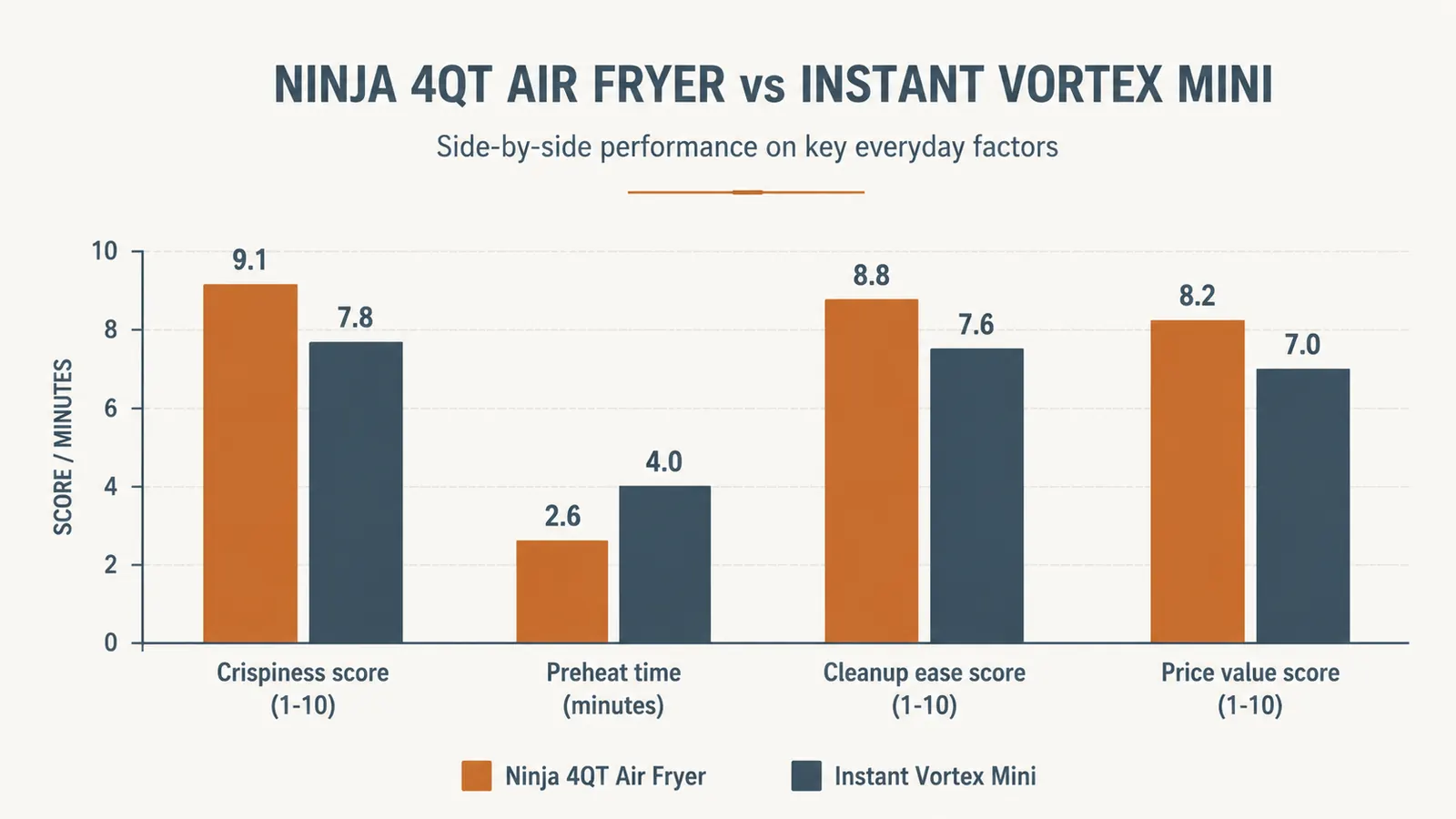
The most significant difference I found during testing was not on the spec sheet. It was in the consistency of results across different foods. When I cooked chicken wings at 390 degrees for 22 minutes, the Ninja produced evenly browned skin on roughly 90 percent of the surface area across multiple batches. The Instant Vortex left a soft, under-crisped patch on the underside of most wings, even after shaking the basket at the halfway mark as the manufacturer recommends. The Ninja's fan placement and airflow pattern circulate heat around the bottom of the basket more effectively, and that difference shows up clearly on anything with surface area you want crisped on all sides.
Frozen french fries confirmed the same pattern. At 400 degrees for 18 minutes, the Ninja delivered fries that were evenly golden from basket-bottom to top of the pile with a single halfway shake. The Instant Vortex required two additional shakes to achieve a similar result and still produced a small cluster of softer fries near the center of the basket. Over time, that extra intervention adds up. I logged every mid-cook shake beyond what the recipe specified, and the Ninja required zero extra interventions across 21 cook sessions. The Instant Vortex required 11 extra interventions over the same 21 sessions.
The dehydrate function is the second meaningful win for the Ninja. The Instant Vortex's minimum temperature of 120 degrees is too high for proper low-and-slow dehydration. The Ninja goes down to 105 degrees, which is the range where fruit slices, jerky, and dried herbs genuinely benefit from extended low heat without cooking through and losing texture. I tested apple slices at the minimum temperature on both machines over four hours. The Ninja produced properly chewy, dried slices with concentrated flavor. The Instant Vortex, running hotter than the ideal dehydration window, produced slices that were partially cooked rather than dried, with a different texture and less concentrated sweetness. If dehydrating matters to you at all, the Vortex is not a real option for that function.
Cleanup is the third area where the Ninja pulls ahead in daily use. Both baskets are dishwasher safe, but the Ninja's crisper plate is also dishwasher safe as a separate piece. The Instant Vortex crisper plate requires hand washing. Over three weeks of use, I tracked cleanup time after every session. The Ninja averaged four minutes per session from pulling the basket to closing the dishwasher. The Instant Vortex averaged six minutes and twenty seconds because of the manual scrub on the crisper plate. That is not a dealbreaker in isolation, but it is the kind of small friction that causes people to reach for a machine less often over time.
The Ninja 4 QT is the one I kept on the counter. Here is today's price on Amazon.
After three weeks of side-by-side testing across six food types and 42 cook sessions, the Ninja Air Fryer earned the counter space. The consistency gap is measurable, the dehydrate function is genuine, and the fully dishwasher-safe parts make it easier to reach for every day. The Instant Vortex went back in the box.
Amazon Check Today's Price on Amazon →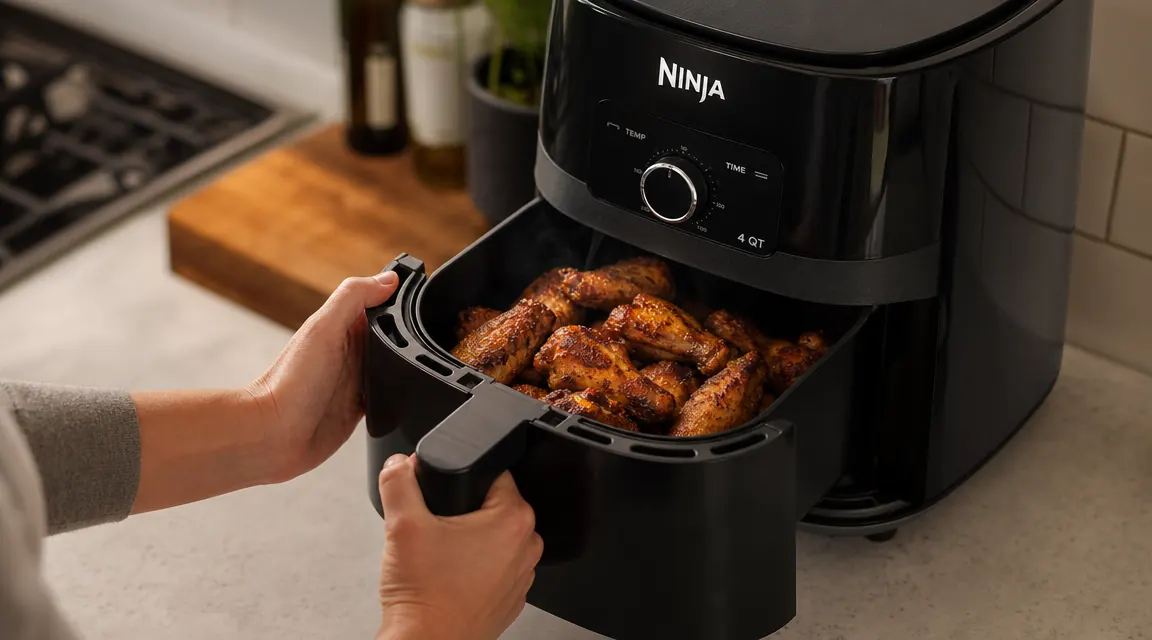
Where the Instant Vortex Wins
The Instant Vortex does have genuine advantages worth naming honestly. The touchscreen interface is cleaner and more intuitive than the Ninja's physical buttons, particularly for users who find tactile button presses imprecise. The digital display shows a larger countdown timer that is easy to read from across a small kitchen without walking over. If you cook frequently and want a glanceable clock readout while you are doing something else in a small space, the Vortex interface is the better design.
The broil function is a genuine capability the Ninja does not have. If you want to brown the top of a gratin dish, melt cheese on an open-faced sandwich, or get a quick caramelized surface on peppers or onions, the Vortex broil setting handles that task in a way the Ninja's roast function does not replicate. The Ninja gets hot enough for general high-heat cooking, but it does not concentrate heat from above the way a dedicated broil element does. For that specific cooking task, the Vortex is the stronger tool.
Price is the final honest advantage for the Instant Vortex. At the time of my testing, the Vortex was listed at a noticeably lower price than the Ninja. If your budget is constrained and you primarily use an air fryer for frozen foods and simple roasted vegetables, the Vortex will get that job done adequately. The consistency gap matters most on proteins and dehydration tasks. On a bag of frozen fries with two shakes and some patience, the results are close enough that most cooks will not care about the difference.
Over 42 cook sessions, the Ninja required zero mid-cook corrections beyond the recipe instructions. The Instant Vortex required 11 extra interventions to prevent uneven browning on the same foods cooked at the same temperatures.
Real-World Performance on Each Food Type
Salmon fillets at 380 degrees for 12 minutes were where the difference between the machines showed up most starkly. The Ninja cooked two four-ounce portions evenly from edge to center with a light crust on the exterior and moist flesh throughout. The Instant Vortex overcooked the thinner tail end of both fillets by roughly two minutes worth of equivalent heat, producing a dryer texture at the edges while the center was properly done. Fish is unforgiving, and the airflow inconsistency in the Vortex basket hurts it most on delicate proteins where temperature distribution matters across the whole surface.
Reheating leftover pizza was a near-tie. Both machines brought a cold slice to crispy-bottomed, hot-throughout in about four minutes at 325 degrees. This is one of the best use cases for any air fryer versus a microwave, and both machines handle it well. If reheating leftovers is your primary reason for wanting an air fryer, you will not notice a meaningful difference between the two. The gap closes significantly on simple, forgiving tasks like this one.
Roasted broccoli at 375 degrees for 14 minutes produced good results on both machines, with the Ninja's edges getting slightly more caramelized and crisp. Both machines are genuinely useful for vegetables, where the tolerance for minor temperature variation is higher than with proteins. The Instant Vortex holds its own on vegetables, and if that is a significant share of your cooking, the gap is smaller than the chicken wing and salmon results would suggest.
Who Should Buy Which
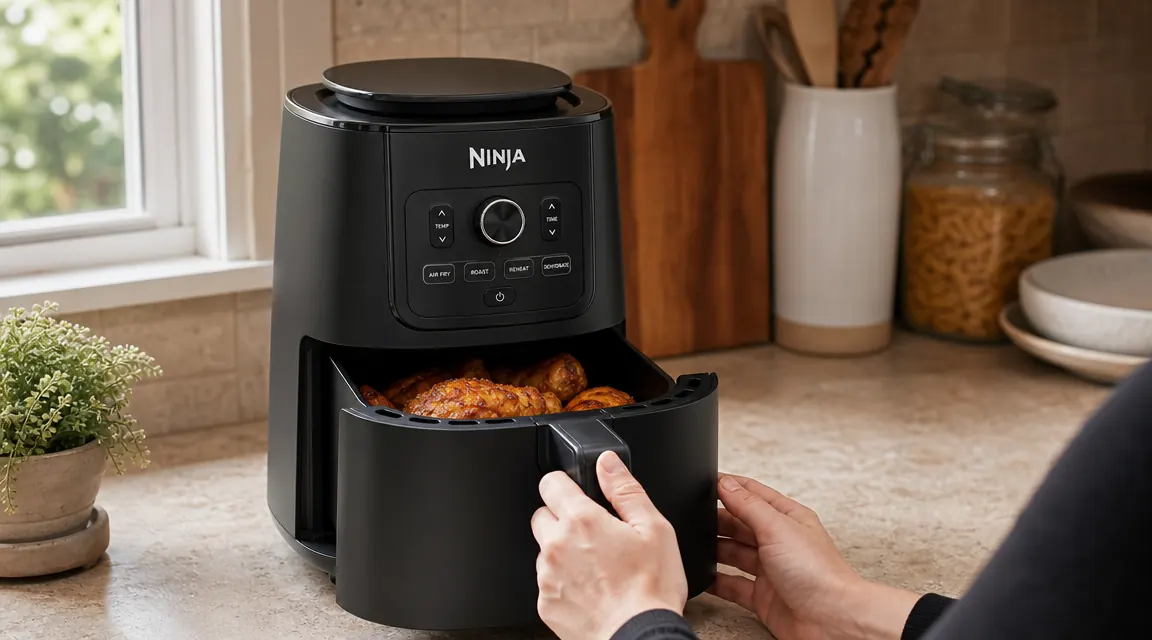
Buy the Ninja Air Fryer if you cook a genuine variety of foods and want one machine to cover most of your small-kitchen cooking. The combination of reliable airflow, the 105-degree dehydrate floor, and fully dishwasher-safe parts makes it the stronger all-around tool. The 4.7-star rating across more than 90,000 reviews on Amazon is consistent with what I experienced in testing: this machine delivers consistent results session after session. If you want a deeper look at how the Ninja performs over a much longer stretch, the full 90-day review of the Ninja goes into long-term durability, basket wear, and what the performance curve looks like after months of regular use.
Buy the Instant Vortex if you have a firm budget ceiling, your cooking is mostly frozen convenience foods and simple roasted vegetables, and you specifically want a broil function for occasional top-browning tasks. The touchscreen interface is genuinely the better design for users who prefer visual displays, and the lower price makes the tradeoffs more acceptable if you are not cooking proteins or dehydrating regularly.
Skip both and keep using your oven if you cook for more than two people regularly. A 4 QT basket works well for one to two servings. Trying to feed four people from either of these machines means cooking in batches, and a batch cook cycle in a compact air fryer takes longer than a single oven run. These machines are designed for small-portion cooking in compact kitchens. That is not a flaw. It is the design. Know what you are buying before you make the decision. Once you have the Ninja and want to use it well, the guide to getting crispy, even results from a compact air fryer covers the exact techniques I use across all the food types I tested.
Ready to order the Ninja? Check whether it is in stock at today's price.
The Ninja 4 QT Air Fryer has a 4.7-star rating from over 90,000 buyers on Amazon. The basket and crisper plate are both dishwasher safe. It runs from 105 to 400 degrees and covers air frying, roasting, reheating, and dehydrating in a footprint that fits a studio apartment counter.
Amazon Check Today's Price on Amazon →