
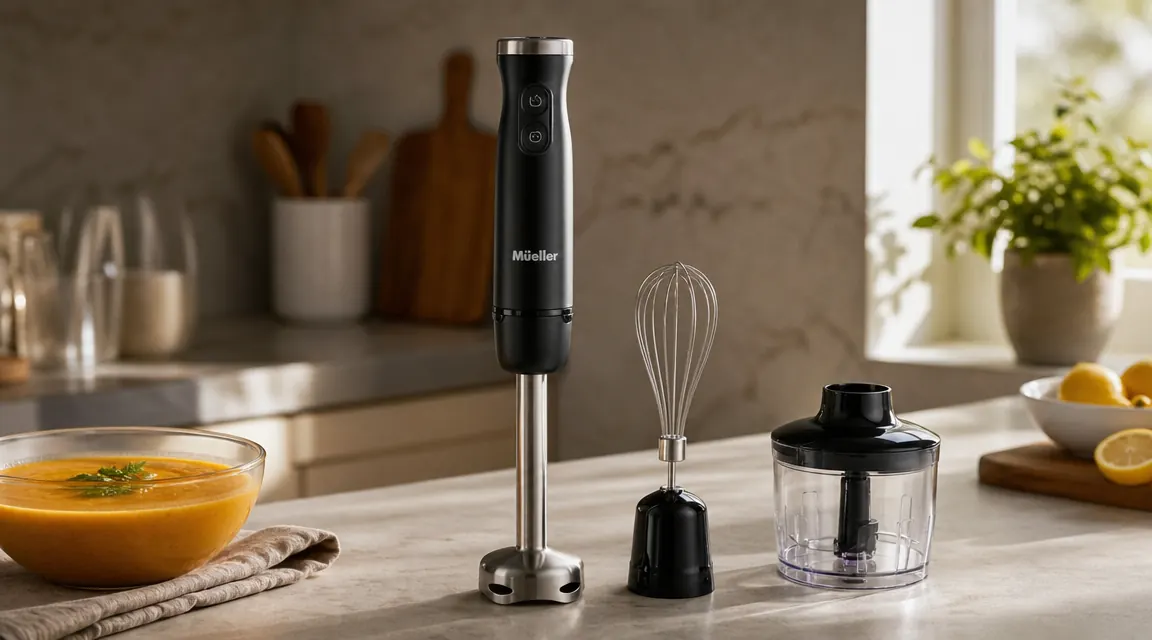
Most immersion blender reviews stop at 'it blended my soup and cleanup was easy.' That is fine if all you need is reassurance. But when a product leads with '500W Heavy Duty Motor' and '8-Speed Turbo' as its headline claims, I want to know what those numbers actually do in a real kitchen, and more importantly, what they do not do. I am Marcus Hale, and I test appliances under repeatable conditions before I say whether they are worth your money. I ran the Mueller Ultra-Stick through six specific tests over four weeks in a 190-square-foot apartment kitchen. Here is what I found, including the parts the glossy product photos leave out.
The short version: the Mueller Ultra-Stick is a competent stick blender that earns its place in most small kitchens, but the 500W label is doing marketing work that the motor does not always back up in demanding tasks, and several of the 8 speeds are so close together that calling them distinct settings is generous. None of that makes it a bad buy. It does mean you should know exactly what you are getting before the box arrives.
The Quick Verdict
Solid everyday stick blender for soups, smoothies, and basic sauces. The 500W claim holds for light-to-medium tasks. Push it harder and the limitations become real, not theoretical.
Amazon Check Today's Price →Want the blender that handles small-kitchen blending without the bulk of a countertop machine?
The Mueller Ultra-Stick is a reliable daily driver for soups, smoothies, and sauces at a price that does not require a second thought. See today's price before deciding.
Amazon Check Today's Price on Amazon →How I Tested It
I structured the tests around the three claims on the product page: motor wattage, speed range, and the included attachments. For motor load, I blended a 32-ounce batch of hot butternut squash soup, a 16-ounce frozen-fruit smoothie made from frozen mango and frozen banana with only half a cup of almond milk added, and two tablespoons of raw almonds submerged in water. Each test was timed from blend-start to target consistency, and I noted audible motor strain, blade stall, and heat in the handle after the run completed. For the speed range, I recorded perceived output change across all 8 settings using a simple resistance test with thick Greek yogurt. The whisk and frother attachments each got two separate sessions: one for whipped cream starting from cold heavy cream pulled straight from the refrigerator, one for frothing whole milk to standard latte temperature at about 150 degrees Fahrenheit.
I also tracked cleanup time after each session, cord management in my kitchen's single narrow utility drawer, and whether the stainless blending shaft showed any discoloration or warping after repeated submersion in liquid at boiling temperature. Nothing fancy, no lab equipment. Just the kind of methodical repetition you would want from someone telling you whether to spend mid-range money on a kitchen tool.
The 500W Motor: What It Handles and Where It Struggles
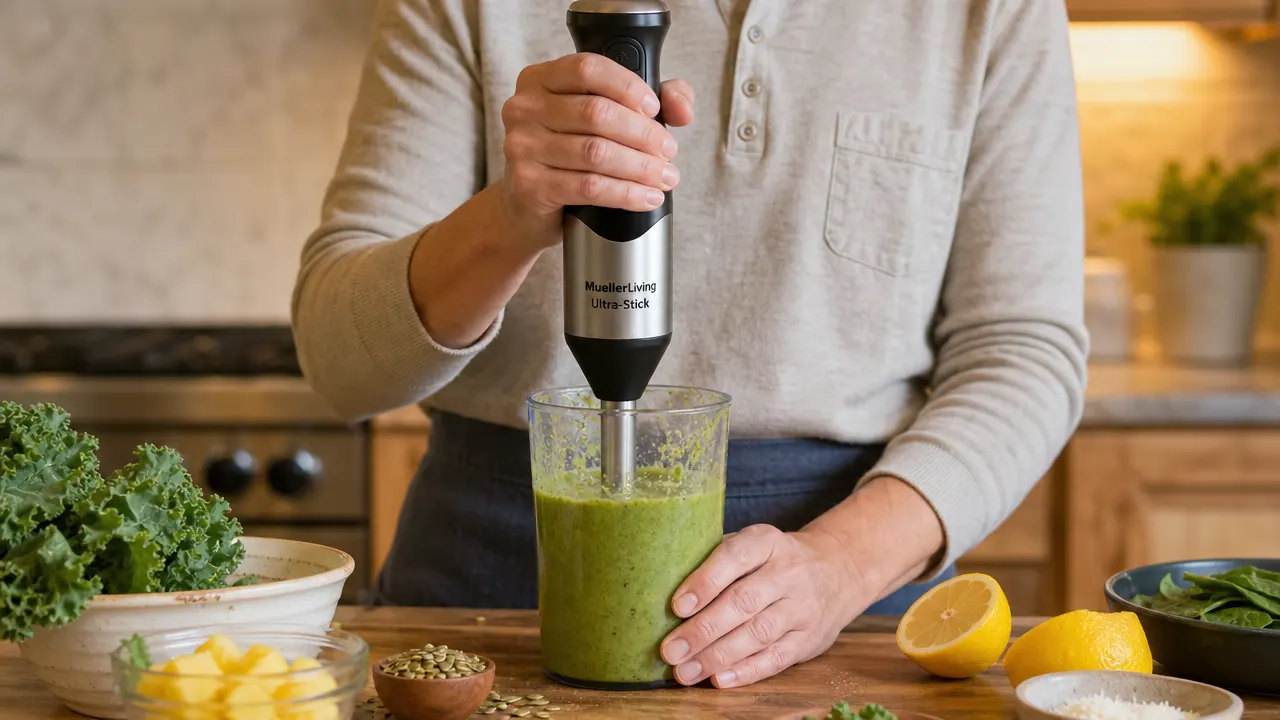
Hot soups and soft-cooked vegetables are genuinely easy for this motor. A 32-ounce batch of butternut squash, fully roasted and soft, blended to a smooth puree in under 90 seconds at speed 5. Zero stall. The blade guard kept splatter contained and the motor ran cool throughout. This is where the 500W rating feels accurate. For everyday soup blending in small batches, the Mueller does exactly what it says.
Frozen fruit is a different story. The frozen mango and banana mix required speed 8, full downward pressure on the blade, and still took over three minutes to reach a drinkable consistency. The motor audibly strained during the first minute, and the handle became noticeably warm by the end of the run. I would not call that dangerous, but it is worth noting that the 500W motor is working at or near its ceiling with a dense frozen load. If you regularly make thick frozen smoothies, you will hit this ceiling and the experience will feel less like a powerful tool and more like coaxing the machine to finish the job. The noise level also climbs considerably at high load, which matters in a small apartment at seven in the morning.
Raw almonds in water were a clear fail. The blade bounced off unsoaked almond pieces rather than cutting through them. After soaking the almonds overnight, the result was better but still left visible texture rather than a smooth consistency. If you are expecting nut butter performance from this stick blender, lower those expectations considerably. The Mueller is engineered for liquids and soft solids, not dry or dense grinding tasks.
The 8-Speed Range: Useful Range or Marketing Number?
This is the finding that surprised me most going in. I expected 8 meaningfully distinct speeds. What I found was closer to three functional zones with several duplicate-feeling steps in between. Speeds 1 and 2 feel nearly identical in resistance tests. The same is true of speeds 5 and 6, and again of speeds 7 and 8. The real breaks you actually notice are roughly: low (1-2), medium (3-4), medium-high (5-6), and high (7-8). That gives you four effective speed levels, which is honestly fine for a stick blender. Most tasks only need two or three distinct power levels anyway. But if you read '8 speeds' and picture 8 distinct steps of increasing power, the chart below shows the more honest picture.

The speed dial itself is smooth and easy to turn with one hand while the other steadies the pot. That is a genuine usability win. The trigger button locks into continuous-run mode cleanly, and the thumb-release disengages without fidgeting. The ergonomics of the handle are well thought out for right-handed use. Left-handed users may find the speed dial position slightly awkward when working at high speeds. None of the mechanical controls felt loose or cheap during four weeks of daily use, which is a reasonable signal for build quality at this price.
The 8 speeds collapse into roughly four functional zones. That is fine for daily use. Just do not expect 8 meaningfully different power steps.
Splatter, Cord, and the Cleaning Reality
Splatter is the real-world dealbreaker for a lot of stick blender users and it deserves an honest answer. The Mueller's blade guard bell is 3.5 inches in diameter, which is narrower than some competing models. It fits inside a standard 2-quart saucepan without crowding the sides, but in a shallow pan or skillet the guard sits close to the liquid surface and splatter occurs at speeds above 4. The fix is straightforward: keep liquid depth at least 3 to 4 inches before blending, and start at a lower speed before ramping up. Follow that process and splatter is controllable. Push the blade near the surface at high speed without thinking and you will redecorate your backsplash.
The cord is 5 feet long and non-removable. In a small kitchen with a single outlet positioned near the counter, 5 feet is usually sufficient. Storing a cord-attached stick blender in a narrow drawer alongside other utensils is genuinely awkward, though. The cord tangles with whisks, ladles, and other long tools. Some comparable blenders ship with a small storage hook or clip to address this. Mueller does not include one. That is a minor gap worth knowing about if your storage situation is already tight.
Cleanup takes about 45 seconds when you do it right after use. Submerge the blade end in soapy water, run the motor for 10 seconds at speed 3, rinse under warm water. The blade guard is dishwasher safe and survives the top rack without warping. The catch most people learn by experience: the whisk attachment has a coiled wire design with small interior gaps where whipped cream and yogurt trap and dry hard if you leave it sitting. Clean all three attachments within 10 minutes of use and there is no scrubbing involved. Leave them on the counter for two hours and you will spend more time on cleanup than you saved blending.
The Whisk and Milk Frother: Worth Using or Just Included?

The whisk attachment produced functional whipped cream from cold heavy cream in about 2 minutes and 40 seconds at speed 7. That is slower than a stand mixer whisk by a significant margin, and it requires a deep, narrow container to contain the splatter. The result at the 2-minute-40-second mark was soft peaks. I pushed to 4 minutes and reached stiff peaks that held their shape. For a small kitchen with no stand mixer, this attachment is a genuinely useful option for occasional whipped cream. It is not efficient, but it does the job without pulling a dedicated appliance from a cabinet or shelf.
The milk frother is the weakest of the three attachments and the one I would not count on as a real daily-use tool. At standard latte milk temperature around 150 degrees Fahrenheit, it produced micro-foam that held for roughly 30 seconds before it broke down and the bubbles separated. That is enough to dress a latte if you pour immediately after frothing, but it is not the textured, durable foam you get from a dedicated milk frother or from the steam wand on an espresso machine. If you froth milk once or twice a week as a small treat, the included frother is adequate. If it is part of your daily coffee ritual, you will find yourself underwhelmed within the first two weeks.
What I Liked
- Handles hot soups and soft-vegetable purees smoothly with no motor strain at moderate speeds
- Ergonomic handle with smooth one-hand speed dial works well for right-handed use
- Blade guard fits standard 2-quart saucepans; easy to control submersion depth and limit splatter
- Quick cleanup: blade end rinses in 45 seconds with the run-in-soapy-water method
- Whisk attachment produces functional whipped cream when used in a deep, narrow container
- 51,628 Amazon reviews provide a large real-world signal; 4.4 average is a credible rating for a mid-range tool
Where It Falls Short
- 500W motor strains audibly with frozen fruit and dense loads; handle runs warm under sustained high-speed use
- 8 speed settings collapse into roughly 4 functional zones; adjacent speeds feel nearly identical in practice
- No storage hook or clip included; 5-foot non-removable cord tangles in narrow utility drawers
- Milk frother attachment produces unstable foam that breaks down within 30 seconds of pouring
- Whisk coil design traps food residue if not cleaned immediately after every single use
- Narrower blade bell than some competitors increases splatter risk in shallow pans at speeds above 4
Comparing It to What You Might Already Own
If you own a full-size countertop blender that occupies a permanent spot on your counter, the Mueller will replace it for roughly 80 percent of your weekly tasks. Soups, sauces, fresh-fruit smoothies, salad dressings, pancake batter, hummus, and baby food all fall within what this motor handles reliably. The 20 percent it cannot replace includes dense frozen blending done daily, nut processing, and any task requiring sustained high-torque grinding for more than two to three continuous minutes. If those tasks are rare in your kitchen, trading a bulky countertop unit for a slim stick blender stored in a drawer is an easy call. If frozen smoothies are your morning routine seven days a week, the Mueller's ceiling will frustrate you faster than the price tag justifies.
For a direct side-by-side look at how the Mueller compares to its closest competitor, the full head-to-head test is in the Mueller vs Cuisinart Smart Stick comparison. The short version: the Cuisinart costs a bit more and delivers a more consistent speed range across its settings, but the handle grip is less comfortable for extended blending sessions. Which one wins depends on whether you value ergonomics or consistent power steps. I have run both through the same soup and smoothie tests and the performance gap is real but not large enough to be decisive for most buyers.
Who This Is For
The Mueller Ultra-Stick is the right tool for anyone in a small kitchen who makes soups, sauces, smoothies from fresh or thawed fruit, salad dressings, and occasional whipped toppings. If you are in a one-bedroom apartment, a condo, a dorm room, or any kitchen where a full-size blender is overkill and cabinet space is already claimed by other things, this blender fits that brief well. The price point means it is not a high-stakes decision, and the 4.4-star rating across 51,628 verified buyers reflects that the experience most people have is solid. If you want more context on how the blender holds up over months of daily use, the long-term Mueller review covers the durability side in more detail.
Who Should Skip It
Skip the Mueller if frozen smoothies are a daily ritual, if you regularly process raw nuts or fibrous root vegetables, or if a reliable milk frother for daily lattes sits on your must-have list. The 500W motor is not a 500W all-purpose grinding motor. It is a 500W motor designed for liquid-heavy tasks where the blade does most of the mechanical work. Push it into high-resistance territory on a consistent basis and you will exceed what it was built to handle reliably. In that situation, either step up to a 600W to 700W stick blender or keep a compact countertop blender available for the heavy work and use the Mueller for everything else. It slots well into that supporting role even when it is not your primary machine.
Still fits what you need? The Mueller Ultra-Stick covers everyday small-kitchen blending without the counter footprint.
Over 51,000 buyers have weighed in at a 4.4-star average. At current pricing it is one of the lower-risk appliance purchases in its category. Check today's price and availability on Amazon.
Amazon Check Today's Price on Amazon →